
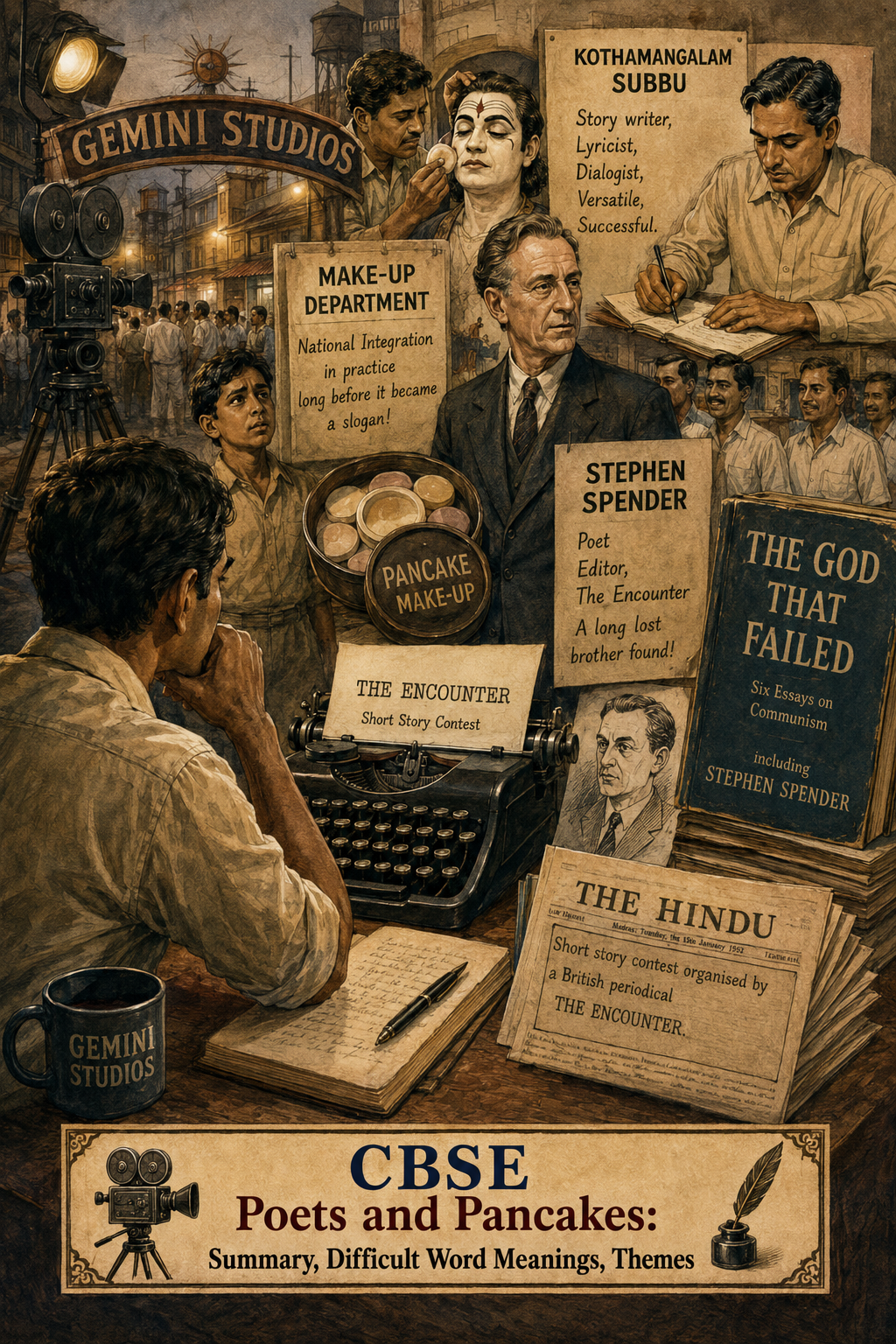

Asokamitran was a renowned Tamil writer who worked at Gemini Studios in Chennai, one of India’s leading film studios during the early years of Indian cinema. His job involved maintaining newspaper clippings, which gave him a close view of the studio’s people and culture. Poets and Pancakes is an excerpt from his autobiographical book My Years with Boss.

Summary-
Pancake was a popular make-up material that Gemini Studios purchased in huge quantities. It was used by many famous film stars such as Greta Garbo, Miss Gohar and Vyjayantimala but Rati Agnihotri who is a newer generation actress may not know about it. The make-up department was located in a building believed to have once been Robert Clive’s stable. (Robert Clive was Bengal’s governor who laid the foundation of the East-India Company)
The room resembled a hair-cutting salon, with large mirrors surrounded by bright incandescent lights that made the process of applying make-up extremely uncomfortable for actors. The author remarks that the thick layers of pancake often made actors appear ugly under the powerful studio lights.
There was a great deal of national integration in the make-up department long before All India Radio and Doordarshan began broadcasting programmes on it. It was headed by people from different regions, including Bengal, Maharashtra, Karnataka, Andhra Pradesh, and Tamil Nadu. This gang of make-up men could turn any decent looking person into a crimson hued monster with their make-up.
A strict hierarchy existed in the department. The chief make-up artist attended to the leading actors, while assistants handled supporting actors. The lowest-ranking employee, known as the office boy, was responsible for applying make-up to crowd artists. Although he was called a ‘boy,’ he was actually in his early forties. Like many others in the film industry, he had joined Gemini Studios dreaming of becoming a famous actor, writer, or director.
In those days, the author worked in a cubicle, two sides of which were French windows. People used to think he did nothing as he only teared up newspapers all the time. Whenever he found the author, he would lecture him endlessly, complaining that his own literary talent was being wasted in the make-up department.
He was convinced that all his problems and failures were due to Kothamangalam Subbu, who was No. 2 at the Gemini Studios. Subbu, in reality, had not been given any advantages in his career rather he had to face more difficulties and uncertainties. The only virtue he had was that he was born a Brahmin. Unlike the office boy, Subbu was cheerful, energetic, loyal and exceptionally talented. He possessed a remarkable ability to solve creative problems instantly and could produce numerous ideas whenever required by the producer. The author remarks that film making is easy when you have a man like Subbu around.
Subbu was also a writer and poet. Although capable of writing sophisticated literature, he chose simple language that appealed to ordinary people. He composed original story poems and the famous Tamil novel ‘Thillana Mohanambal’, which vividly portrayed the lives of Devadasis. He was also an excellent actor who often performed supporting roles more effectively than the lead actors.
He had genuine love for everyone and was a charitable person. Despite these admirable qualities, he had enemies. Maybe it was because people were envious of his relationship with Mr. Vasan, The Boss of the studio or because he was too nice all the time.
Subbu officially worked in the Story Department which comprised of several writers, poets, and a lawyer who also served as the studio’s legal adviser. Once an extremely talented but temperamental actress had an outburst and angrily criticised the producer. The lawyer secretly recorded her speech and later played it back to her. This shocked the inexperienced actress so deeply that she never fully recovered from the embarrassment and her acting career soon ended.
While most employees wore khadi and clumsily tailored clothes, the lawyer wore a pant, a tie and sometimes a coat. He often looked alone because he was a man of logic in a crowd of dreamers. Later, when The Boss closed the Story Department, the lawyer also lost his job.
Gemini Studios was a favourite meeting place for many well-known poets and writers such as S.D.S. Yogiar, Sangu Subramanyam, Krishna Sastry and Harindranath Chattopadhyaya. The studio had an excellent canteen that served coffee throughout the day. Most employees wore khadi and admired Mahatma Gandhi, but they had a limited understanding of politics. Like many people in South India during that period, they viewed Communism with suspicion and believed many exaggerated misconceptions about it.
The author next describes the visit of Frank Buchman’s Moral Re-Armament (MRA) group, an international organisation that promoted moral values and opposed Communism. The group staged two professionally performed plays, ‘Jotham Valley’ and ‘The Forgotten Factor.’ The message of the plays was simple but the sets and costumes were first-rate which impressed the Tamil drama community. Many local productions later copied their techniques.
Some months later, Gemini Studios welcomed another distinguished visitor, a poet from England. Many employees mistakenly thought he was simply an editor because S. S. Vasan himself edited the Tamil magazine Ananda Vikatan. He wasn’t the editor of any of the known British publications in Madras and everyone thought he was an editor of the daily.
The poet was a tall and very serious man. The Boss delivered a vague speech filled with general references to ‘freedom’ and ‘democracy,’ while Spender’s own speech was difficult for the audience to understand because of his English accent. The reception, thus turned out to be awkward.
The author reflects that prose writing cannot be the true pursuit of a genius and unlike poets or geniuses, a prose writer must be patient, determined and able to face repeated rejection without losing hope. This thought comes to the author’s mind when he notices an announcement in The Hindu about a short story competition organised by the British magazine The Encounter. Before sending his story, he visits the British Council Library to learn more about the magazine. There, he discovers that its editor is Stephen Spender, the same English poet who had once visited Gemini Studios. Excited by this connection, the author happily submits his manuscript, imagining a bond between himself and Spender.
Many years later the author bought a cheap copy of ‘The God That Failed.’ The book contained essays by six famous writers who described their attraction to Communism and their later disillusionment with it. One of the writers was Stephen Spender. The author finally understood why Spender was given a grand reception at Gemini Studios. The Boss admired Spender not merely for his literary achievements but because he had publicly rejected Communism.
Difficult Word-Meanings-
- Incandescent – Glowing with bright electric light.
- Hierarchy – A system of ranks or positions.
- Epics – Very long speeches or stories (used humorously).
- Woes – Troubles or sufferings.
- Ignominy – Public shame or disgrace.
- Folk refrain – The simple, traditional style and repeated pattern of folk songs or poetry.
- Diction – Choice and style of words in writing or speech.
- Devadasis – Women dedicated to temple service through dance and music.
- Improvident – Careless about saving money or planning for the future.
- Sycophant – A person who flatters someone powerful for personal gain.
- Direst – Most terrible or severe.
- Tirade – A long, angry speech.
- Coat of mail – A defensive body armour
- Prohibition – Government ban on the sale and consumption of alcohol.
- Prerequisite – Something necessary beforehand.
- Communism – A political system advocating common ownership of property and resources.
- Filial – Relating to the love or duty of a child towards parents.
- Conjugal – Relating to marriage or husband and wife.
- No compunction – No feeling of guilt or hesitation.
- Moral Re-Armament (MRA) – An international movement promoting moral values and opposing Communism.
- Trapeze – A swinging bar used by acrobats in a circus.
- Bafflement – Complete confusion.
- Incongruity – Something that seems out of place or unsuitable.
- Travails – Hardships or difficult experiences.
- Persevering drudge – A person who works patiently and tirelessly despite difficulties.
Themes-
- The World of the Film Industry- The essay reveals that the glamorous world of cinema is built on the hard work of ordinary people. Through the make-up department, the strict hierarchy among employees, and the functioning of the Story Department, Asokamitran shows that film studios were workplaces filled with discipline, creativity, competition, and many unseen contributors.
- Ambition, Success and Frustration- The chapter contrasts the lives of the office boy and Kothamangalam Subbu. While the office boy remains frustrated because his dreams of becoming a writer or actor never come true, Subbu earns success through his creativity, versatility, and dedication. The contrast shows that talent combined with hard work and a positive attitude leads to success, whereas jealousy only increases disappointment.
- Humour and Irony- Asokamitran uses humour and irony to portray life at Gemini Studios. He humorously describes how thick layers of pancake make-up made actors look uglier instead of better and how the make-up department practised “national integration” long before it became a government slogan. The awkward reception for Stephen Spender further highlights the irony and absurdity of many situations in the studio.
These notes help you prepare Poets and Pancakes with confidence. These include detailed CBSE notes including the summary, difficult word meanings and important themes for effective board exam revision.
Here’s a PYQ for you to answer:
Q.- In what manner was the make-up department ahead of AIR and Doordarshan, according to Ashokamitran?
Answer this question in 40-50 words in the comment section to get personalized feedback.


Leave a Reply