
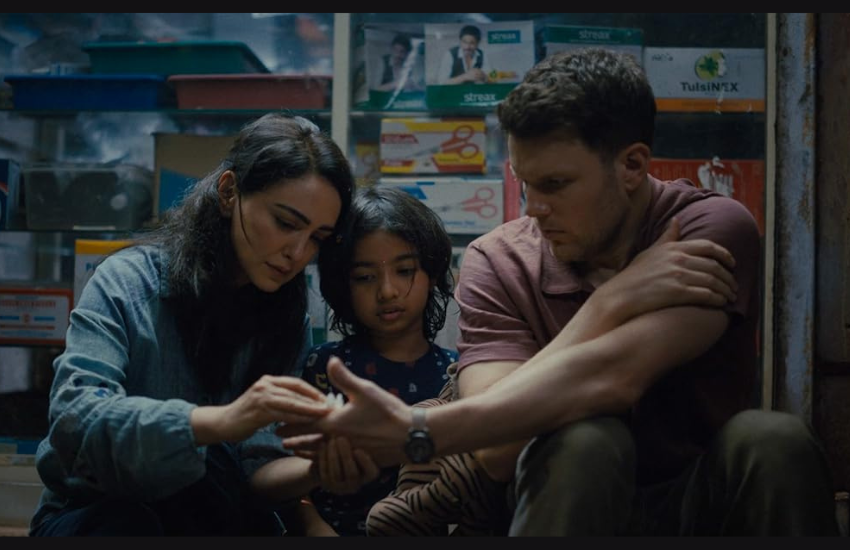
Nicola Rinciari’s A Mosquito in the Ear is, at first glance, a story about two parents travelling to India to bring home their newly adopted four-year-old daughter, Sarvari.
Starring Jake Lacy as Andrew and Nazanin Boniadi as Daniela, the film is inspired by Italian illustrator Andrea Ferraris’ autobiographical graphic novel Una Zanzara nell’Orecchio, which grew out of Ferraris and his wife Daniela’s experience adopting their daughter Sarvari, from India.
The real-life story became the basis for Ferraris’ graphic novel and eventually, this film. But beneath the adoption story is something more complicated: the story of three people who want to become a family, while only two of them understand what that means.
One thing the film wants to do differently is to show the adoption experience from not just the child’s point of view but from the parents’ perspective as well. Andrew and Daniela have been preparing for Sarvari months before actually meeting her. They have seen her photograph, taken classes and imagined the moment when they will finally bring their daughter home. Andrew was even angry when he learnt that unlike them, no one has explained to Sarvari what is happening.

For Daniela especially, motherhood is something she has been waiting to embrace. But when they finally meet Sarvari, everything doesn’t pan out the way they imagined. And from Sarvari’s perspective, that makes perfect sense.
Sarvari is only four but not too young to have a world of her own. She knows the orphanage, the children around her and the women who have cared for her. She has routines, memories and attachments. Most importantly, she knows what it feels like to be loved there. Sister Teresina’s affection for her is particularly evident.
Then two strangers arrive and tell her they are her parents and are going to take her away from the only world she has known.

They don’t speak her language. They can’t understand what she is saying. She has never known them, yet suddenly she is expected to leave with them and trust them. The title itself captures this distance. The unfamiliar English surrounding Sarvari feels like a mosquito in her ear: something irritating, persistent and impossible to understand.
So she runs and pushes them away. She resists their affection and wants to escape from them.
She is looking for an opportunity to go back and she does. She runs away from the hotel they all are staying at.
Once she is alone on the streets, she tries to find the person whose love belongs to the world she understands. She calls out for Sister Teresina but no one comes. The streets that looked ordinary from the safety of the orphanage suddenly become frightening. Strangers shout at her and push her away. She encounters a shopkeeper who chases her when she tries to take something without paying. People ask her, “Mummy kahan hai?” (Where is your mother?)
It is a devastating question because Sarvari does not yet have an answer. Until this point, she has understood Andrew and Daniela primarily as the people taking her away from her home. Now, for the first time, she begins to understand what their absence means.
The world is a cruel place for a child with no parents. Without her parents, Sarvari has no protection and no one to return to. The freedom she thought she wanted suddenly looks very different when she is actually alone.
This is perhaps the most important moment in Sarvari’s journey in the film. She does not suddenly become grateful to her adoptive parents or magically understand everything about adoption. Instead, she experiences, in the simplest and most frightening way possible what life can feel like for a child without a stable home and dependable adults to protect her.
And then she sees Andrew. For a moment, Sarvari hesitates.
She could run again. Andrew is still the man she has struggled most to accept as Sister Aruna explained to Andrew when he was confused by Sarvari’s lack of response towards him that Sarvari has never lived with a man before and her world has been shaped almost entirely by women at the orphanage. Daniela has gradually become someone she can approach but Andrew represents another unfamiliarity altogether.
But Sarvari does not run. She watches him calling her name and then after a moment of consideration runs into his arms. The resistance that has defined their relationship breaks. And then come the tears, the overwhelming tears of a four-year-old who has finally found the person she can feel safe with.

The wounds they both carry afterwards make the moment even more poignant. When they return to Daniela, she tends to both of them, dressing their wounds and bringing the three of them together in an ordinary, intimate family moment.
And that is where A Mosquito in the Ear finds its most affecting definition of family. It is not the moment when the adoption papers are signed. It is not the moment Andrew and Daniela first see Sarvari’s photograph. And it certainly isn’t the moment they arrive to take her home.
It is the moment when Sarvari, after experiencing the world without them, chooses to go back.
Perhaps that is why the film’s parent-child relationship feels more honest than a conventional adoption story. Andrew and Daniela cannot simply declare themselves Sarvari’s parents and expect a four-year-old to feel the same way. They have to wait for her to discover what their presence means.
And Sarvari has to discover that herself.



Leave a Reply