
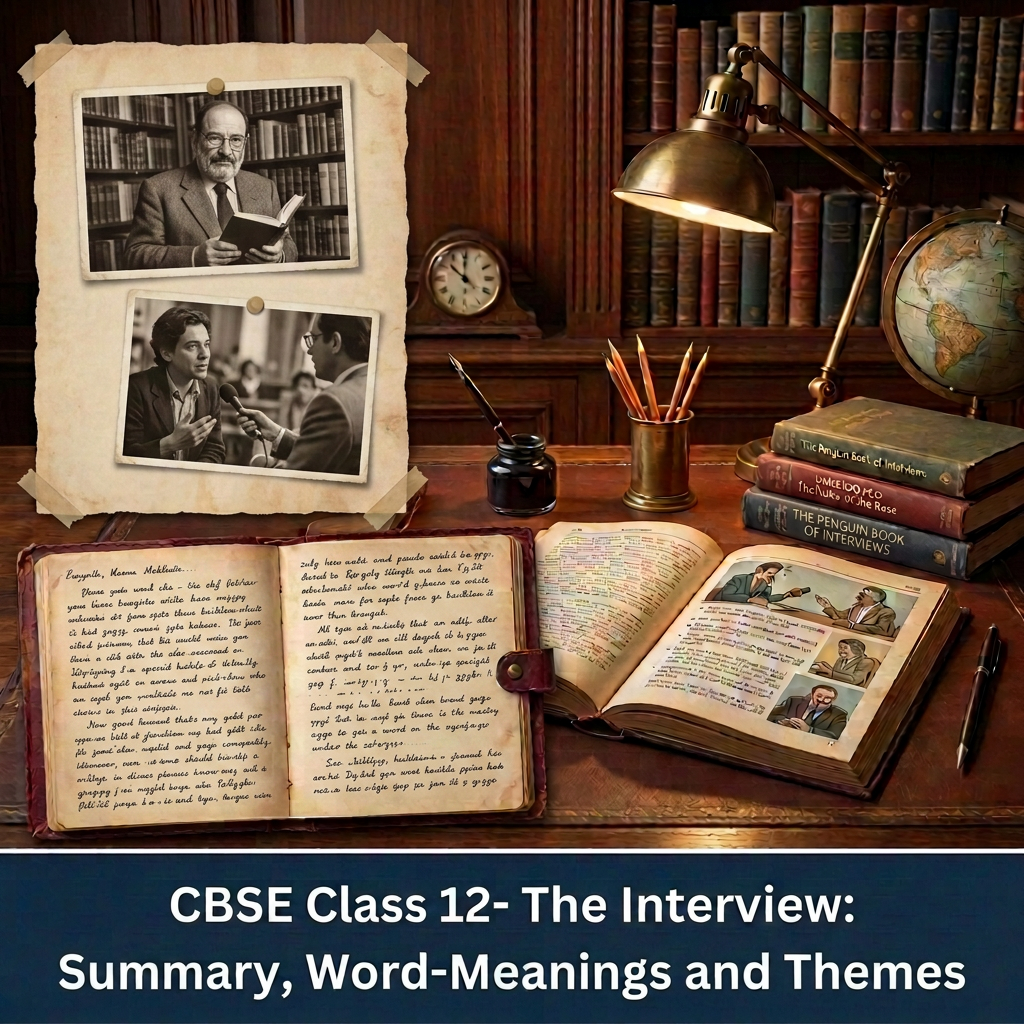

Christopher Silvester is a British journalist, writer, editor and historian. He worked as a reporter for Private Eye for over a decade, later writing for publications such as Vanity Fair. He edited The Penguin Book of Interviews: An Anthology from 1859 to the Present Day, examining the evolution, significance and controversies surrounding interviews in journalism. The chapter The Interview is adapted from his introduction to this anthology.

Summary-
Part I
The author begins by observing since the invention of the interview a little more than 130 years ago, it has become so common that almost every literate person has read one at some point. Thousands of celebrities have also been interviewed and because of its widespread use, people have very different opinions about it.
Some consider it as a source of truth and an art. However, many celebrities regard interviews as an unwelcome intrusion into their private lives. Silvester compares this feeling to the belief in some primitive cultures that photographing a person steals that person’s soul.
V. S. Naipaul believed that some people are wounded by interviews and lose a part of themselves. Lewis Carroll, the creator of Alice in Wonderland, had a deep fear of interviewers and never agreed to be interviewed. Rudyard Kipling’s wife, Caroline, recorded in her diary that two reporters from Boston had ruined their day. He considered an interview immoral and believed that asking someone for it was cowardly and vile. Interestingly, Kipling himself had interviewed Mark Twain a few years earlier.
H. G. Wells despite describing it as an ‘interviewing ordeal’, frequently participated in interviews and many years later even interviewed Joseph Stalin. Saul Bellow, although agreed to several interviews once compared interviews to ‘thumbprints on his windpipe.’
Denis Brian has written that in the modern-world, interviews are one of the main ways through which people form impressions of important contemporary personalities. Much of the important information reaching society comes through one person asking questions of another. Therefore, the interviewer has an unprecedented position of power and influence.
Part II


It is an extract from an interview with Umberto Eco, a professor at the University of Bologna, Italy, conducted by Mukund Padmanabhan of The Hindu. Eco was a renowned scholar, semiotician and novelist who wrote academic texts, fiction, essays, children’s books and newspaper articles and whose ‘The Name of the Rose’ sold over 10 million copies.
Mukund begins by referring the English novelist and academic David Lodge, who wondered how one person can do all the things that Eco does. Eco responds that although he may appear to be doing many things, he is essentially doing the same thing. His academic work and novels are connected by his philosophical and ethical interests. Even his children’s books deal with subjects such as peace and non-violence.
Eco then shares a secret. He explains that if the empty spaces in all the atoms were eliminated, the entire universe would become as big as his fist. In the same way, he says that our lives also contain many empty spaces, which he calls ‘interstices.’ Eco works in these empty spaces. He gives the example that while waiting for someone to come in an elevator from the first floor to the third, he may already have written an article.
Mukund next asks Eco about the personal and playful quality of his academic writing which is different from the usual dry, boring and depersonalized style of it. Eco explains that when he wrote his doctoral dissertation at the age of 22, a professor observed that instead of simply presenting conclusions, Eco had narrated the entire story of his research including his trials and errors. The professor appreciated this approach and eventually published the dissertation as a book.
This taught Eco that scholarly books should be written by telling the story of the research. This is why, he started writing fiction relatively late, at about the age of 50. He remembers his friend Roland Barthes always wanted to become a novelist but died before he could do so. He never felt this frustration because he began writing novels as by accident as novels suited his natural love of narration.
The interviewer then talks about his enormous success as a novelist. Although he has written more than forty scholarly works, the people know him as the novelist who wrote ‘The Name of the Rose.’ Eco admits that it bothers him as he considers himself a university professor who writes novels on Sundays. He participates in academic conferences rather than writers’ organisations.
At the same time, he accepts that novels reach a much larger audience and recognises that he cannot expect a million people to read a scholarly book on semiotics.
Mukund then asks why ‘The Name of the Rose,’ despite being a serious and intellectually demanding novel dealing with detective fiction, metaphysics, theology and medieval history became such a massive bestseller. Eco says that journalists and publishers are often surprised because they assume people like trash readers and prefer easy reading.
The novel sold between 10 and 15 million copies, still a small percentage of the world’s population. But the people who read his novel were precisely those who were willing to engage with a difficult reading experience. He also acknowledges that people do not always want or need this. He himself enjoys watching light television programmes such as Miami Vice or Emergency Room after dinner.
Finally, Mukund asks if the success of the novel could be connected with its medieval setting. Eco replies that it is possible but narrates how his American publisher didn’t expect to sell more than 3,000 copies because in America people do not encounter cathedrals or study Latin. Surprisingly, the novel eventually sold two or three million copies in the United States.
He concludes that the novel’s enormous success remains a mystery. Many books had already been written about the medieval past. He believes that if he had written it ten years earlier or ten years later, it might not have achieved the same response. Therefore, why the novel was a success at that particular time remains a mystery.
Difficult Word-Meanings:
- Intrusion- Unwelcome interference in someone’s private life
- Primitive- Belonging to ancient, less-developed cultures
- Ordeal- A difficult or unpleasant experience
- Thumbprints on windpipe- Feeling oppressed or choked
- Semiotics- Study of signs and their meanings
- Medieval aesthetics- Study of beauty in medieval art
- Ethical- Relating to moral principles and values
- Invariably depersonalised- Always lacking personal or individual expression
- Dissertation- A detailed academic research paper
- Hypotheses- Proposed explanations that need further proof
- Detective yarn- An engaging story involving mystery and investigation
- Metaphysics- Study of reality beyond the physical
- Theology- Study of religion and religious beliefs
- Cathedral- A large and important Christian church
Themes-
- Interview as a Powerful Journalistic Medium- The chapter presents the interview as an important form of journalism and communication. It can provide valuable insights into the thoughts, experiences and personalities of prominent people. However, it is also viewed by some celebrities as an intrusion into their private lives.
- Time Management and Productive Use of Life- Eco’s idea of ‘interstices,’ highlights the importance of using small intervals of time productively. He utilises these apparently empty moments for creative work such as writing an article while waiting for an elevator. His habit demonstrates discipline, efficiency and an active approach to time making even insignificant moments meaningful and productive.
- Conflict Between Privacy and Public Curiosity- A significant theme is the conflict between a public figure’s right to privacy and the public’s desire to know more about them. Writers such as Lewis Carroll, Rudyard Kipling and Saul Bellow disliked interviews because they felt exposed or diminished by them. It raises questions about the limits of journalistic curiosity and personal boundaries.
These comprehensive notes on The Interview help Class 12 CBSE students revise the chapter with confidence. Covering a detailed summary, difficult word meanings, and important themes, they provide focused study material for effective board exam preparation and quick revision.
Here’s a PYQ for you to answer:
Q.- Most celebrity writers despise being interviewed. Why?
Answer this question in 40-50 words in the comment section to get grammar checks and personalized feedback on your answer.


Leave a Reply