
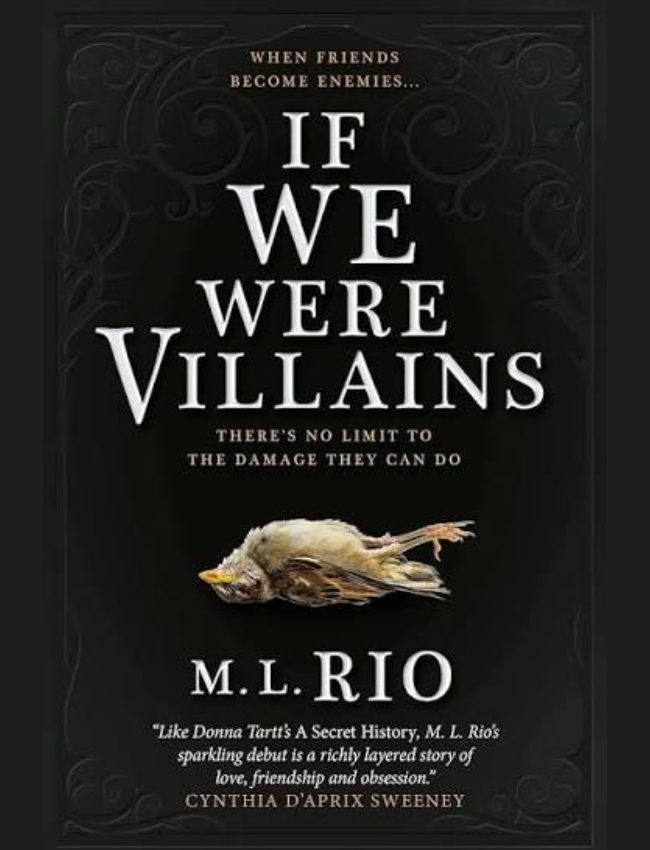
I finally got out of my reading slump and read If We Were Villains by M.L. Rio. I’d describe this book as a dark-academia mystery, a whodunit with a whole lot of Shakespeare. The novel is saturated with Shakespearean references, from its five-act structure to its characters, performances, dialogue, and major plot points. It is divided into a five act structure just like Shakespeare’s plays and includes major parallels in the plot points as well.

A Quick Introduction
At the Dellecher Classical Conservatory, seven fourth-year acting students have survived years of competition to become the best of the best. Ten years later, Oliver Marks walks out of prison after serving a sentence for murdering one of his classmates.
What I Didn’t Like About the Book
There are spoilers ahead, so I’m assuming you’ve also read the book. If not, you can read it and come back to this post. There’s nothing I love more than sharing thoughts and having discussions with fellow readers.
My biggest problem was Richard’s anger and his increasingly violent behaviour. In the beginning, he is one of them, but slowly becomes abusive towards the group, particularly James. His jealousy over Meredith and Oliver’s closeness and James’s relationship with his cousin Wren are offered as explanations, but I never felt there was enough justification for the intensity of his behaviour. I struggled to see him as the villain the narrative seemed to want me to see.
I also found the female characters grossly underdeveloped. Apart from James and Oliver, I don’t think the other characters are given enough room to be truly dynamic. Meredith is constantly objectified and sexualized, Filippa often seems to exist when the plot requires her presence and Wren is repeatedly presented as excessively emotional and tearful adding emotional weight to the book.
This is how Oliver describes the three of them when they are playing the three weird sisters of Macbeth
“On the left, Filippa, her long legs and slim hips unmistakable. On the right, Wren, smaller and slighter than the other two. In the middle, Meredith, her curves bold and dangerous under the thin white shift.”
Shakespeare Is Not Just a Reference
The Shakespearean influence begins with the title itself, ‘If We Were Villains,’ taken from Edmund’s speech in King Lear. In the speech, Edmund questions the idea that people are inherently villains, blaming fate and the stars for their actions. The book similarly asks whether people become villains by choice or circumstance.
Shakespeare’s plays don’t simply appear as performances within the story. They become a framework through which the characters understand themselves.

The first major play is Julius Caesar. Richard plays Caesar, while James plays Brutus. Before the performance, Frederick asks the students a deceptively simple question: what is more tragic: Caesar being assassinated, or being assassinated by his intimate friends?
That question practically announces what is coming.
Richard dies in Act III, just as Caesar did. James is responsible for striking the fatal blow, just as Brutus participated in Caesar’s assassination. Brutus believed Caesar must die for the good of Rome, while James believes Richard must die to protect his friends.
And this is where I think the novel’s real question lies: What is more violent: the person who commits the murder, or the people who allow it to happen? James may have delivered the fatal blow, but the others ultimately choose to let Richard die.
I still don’t think Richard deserved to die. I never found the novel’s justification for turning him into such a villain entirely convincing. But Shakespeare makes the question of betrayal more important than the question of innocence.
Then comes Macbeth, and the parallels become almost unsettling.
For the Halloween performance, the students are secretly assigned their roles and are forbidden from rehearsing together. James becomes Macbeth, Oliver becomes Banquo and Richard is reduced to the voice of the apparitions.
Richard is obviously furious. He subjects James to this violence during the rehearsals and after the Macbeth performance nearly drowns him.
The casting also creates another fascinating parallel. James is an actor who completely immerses himself in his roles. So as he plays Macbeth, a character increasingly consumed by murder, ambition and guilt, his own life begins moving in the same direction.
Richard, meanwhile, becomes almost literally an apparition. After his death, he continues to haunt the group psychologically, much as the apparitions haunt Macbeth.
Then Shakespeare gives Oliver and James their own Romeo and Juliet tragedy. Their relationship moves from friendship into something neither of them can comfortably name. During the final performance of King Lear, their relationship finally breaks through the performance itself.
And King Lear provides perhaps the most fitting final parallel. James plays Edmund, while Oliver plays Edgar, the illegitimate and legitimate brothers locked into a story of betrayal, violence and eventual ruin.
The final performance becomes almost impossible to distinguish from reality. James, as Edmund, is confronted by Oliver as Edgar while Detective Colborne waits in the wings. James knows the truth is about to come out. Oliver knows it too. And instead of allowing James to confess, Oliver takes his place.
Even the Names Have Shakespearean Origins
The Shakespearean influence extends beyond the students and their performances finding its way into the names of several characters around them.
Frederick recalls Duke Frederick from ‘As You Like It,’ Camilo, the fight choreographer and personal trainer shares his name with a character in ‘The Winter’s Tale,’ Dean Holinshed refers to Raphael Holinshed, whose ‘Chronicles’ heavily inspired the subject matter of Macbeth and Gwendolyn’s name is was taken from the character of Guendoline in the play ‘Locrine’. This play was published in the third folio and is one of those plays whose authorship has been attributed to Shakespeare but it is still debated.
And then there is ‘Pericles,’ which may be the most important Shakespearean reference in the entire novel.
At the beginning, Oliver auditions using a speech from Pericles. Years later, James leaves Oliver a note composed from a passage in the play. In Pericles, the protagonist believes his wife Thaisa has died at sea, but she has actually survived and is eventually reunited with him.
Oliver has been told that James drowned himself. But James’s body was never found. Oliver recognizes the implication in the passage and begins researching James’s death. The novel ends without confirming whether James is alive leaving the possibility deliberately open.
Personally though, I thought the ending was ambiguous for the sake of being ambiguous. The possibility is there but the lack of necessity made it feel somewhat manufactured.
Shakespeare Is the Only Language They Know
This is ultimately why I found the Shakespearean aspect of If We Were Villains much more interesting than the mystery itself.
The characters don’t simply perform Shakespeare. They use Shakespeare to explain themselves. They assign each other archetypes: the hero, the villain, the temptress, the ingénue. They fall into those roles until it becomes difficult to tell where performance ends and real life begins.
I would not call If We Were Villains one of the greatest books I have ever read. But the amount of research and thought M. L. Rio has put into Shakespeare is genuinely commendable. The Shakespeare references aren’t random decorations placed around a dark-academia setting. They form the skeleton of the novel.
And perhaps that is the most Shakespearean thing about it.
The characters spend the entire book performing tragedies written hundreds of years before they were born and then, slowly and almost inevitably, they begin creating one of their own.


Leave a Reply