

Louis Fischer was an American journalist and author, born in Philadelphia. He briefly served in the British Army before beginning his career in journalism. He wrote for The New York Times and later The Saturday Review. Deeply interested in India’s freedom struggle, he authored The Life of Mahatma Gandhi, from which the chapter Indigo has been adapted.

Summary-
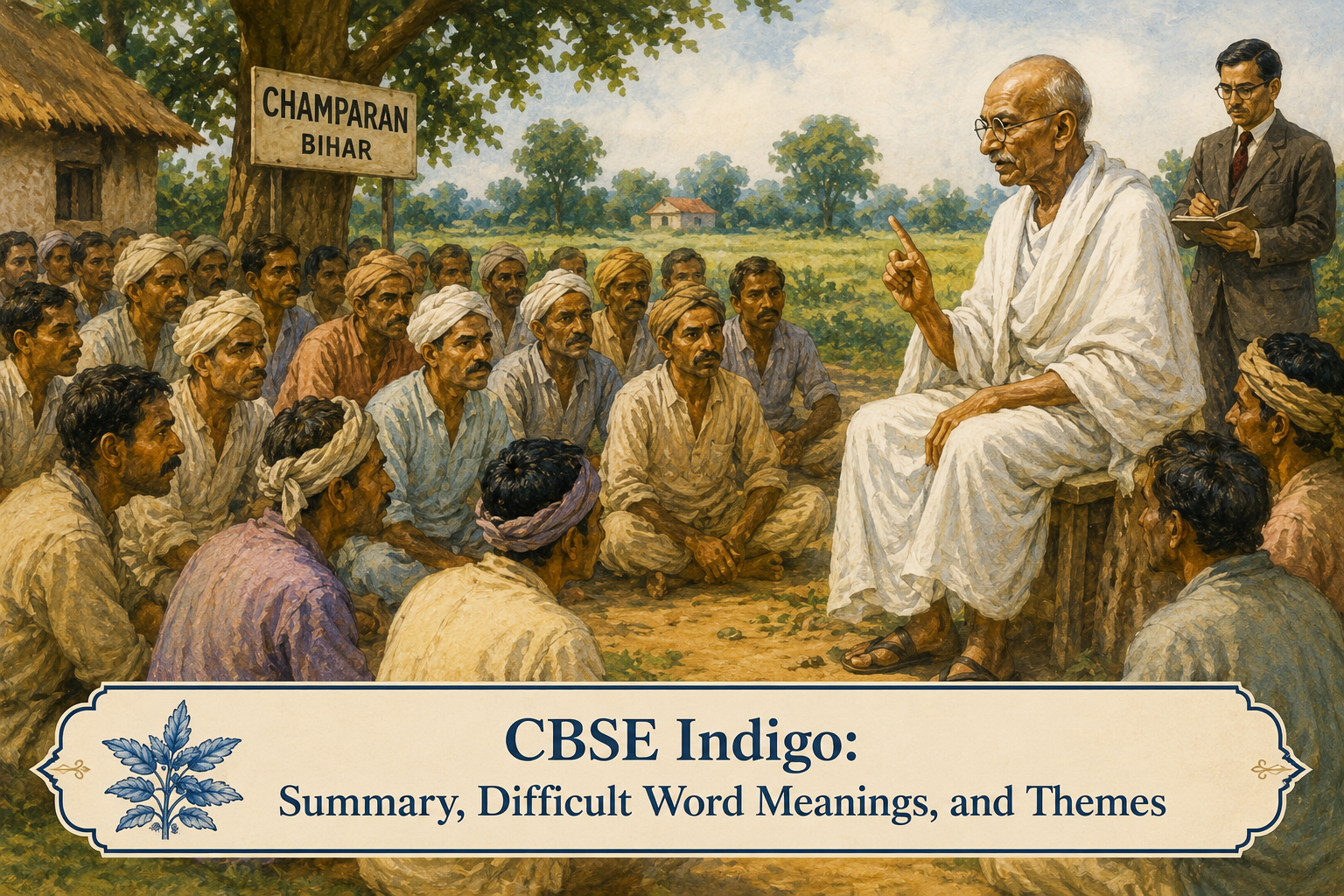
The author recounts the time when he visited Mahatma Gandhi in his ashram in 1942. Gandhi tells him about the first successful experiment with civil disobedience in India during the Champaran movement of 1917.
Rajkumar Shukla, a poor but determined peasant from Champaran came up to him at the annual convention of Indian National Congress in 1916. He was one of the sharecroppers and wanted to complain about the injustice of the landlord system in Bihar. He pleaded to Gandhi to visit his district and eventually Gandhi agreed.
Shukla took him to meet Rajendra Prasad, a lawyer who later became the President of the Congress party and India. Although Prasad was not at home but the servants let them stay on the grounds. However, Gandhi was not allowed to draw water from the well in case he was an untouchable.
Gandhi decided to gather more information about the conditions by sending telegrams to professors in Muzzafarpur. He stayed in the home of a professor there for two days which was an unusual thing in those days because Indians were afraid to show sympathy for advocates of home-rule.
People from Muzaffarpur and Champaran started to gather around him. The lawyers called upon him to brief him but he decided that law courts cannot solve the peasants’ problems. They will get real relief only when they are free from fear.
The agricultural land in the Champaran district was controlled by British landlords and the Indians were tenants. The peasants were forced to grow indigo on 15% of the land and then surrender the entire harvest as rent. After learning that Germany has developed synthetic indigo, they demanded compensation from the sharecroppers to be released from the arrangement. Because the arrangement was bothersome, many of them agreed to pay but when they learned about the synthetic indigo, they wanted their money back.
When Gandhi arrived, he went to the secretary of the British landlord’s association who called him an outsider. The commissioner of the Tirhut division bullied him and asked him to leave the place. He went to Motihari where a large number of people greeted him. He set out on an elephant to see an ill-treated peasant. The police superintendent’s messenger asked him to return. He did but disobeyed the official notice. Therefore, he received a summons to appear in court next day. Gandhi called Rajendra Prasad and asked him to come with influential friends.
Thousands gathered around the courthouse and the officials asked him to regulate the crowd. The trial was postponed. Gandhi pleaded guilty and declared that he was acting according to the voice of his conscience. Eventually, he was released by the judge without bail.
Several prominent lawyers such as Rajendra Prasad, Brij Kishor Babu and Maulana Mazharul Huq arrived from Bihar to confer with Gandhi about his trial. They thought that if Gandhi, a total stranger was willing to stand with the sharecroppers then they should also not desert them. They were also ready to follow him into jail. However, the case was dropped. For the first time, civil disobedience had won in modern India.
Gandhi and the lawyers then proceeded to carry out a detailed investigation into the grievances of nearly ten thousand peasants. The Lieutenant-Governor then summoned Gandhi and after four long interviews, an official inquiry commission was appointed with Gandhi as the sole representative of the peasants.
After much evidence was assembled against the British planters, they were expecting a demand of the full repayment of illegally extorted money. Instead, Gandhi accepted a settlement of 25% refund of the total amount because he believed that the amount itself was less significant than the fact that the landlords had admitted their wrongdoing. The peasants had learned courage. Within a few years, British planters left their estates and indigo sharecropping disappeared.
To do something about the cultural and social backwardness of the Champaran villages, Gandhi appealed for teachers. His young disciples, Mahadev Desai and Narhari Parikh cam forward along with his youngest son, Devadas and Mrs. Kasturbai Gandhi. They opened primary schools in villages, spread awareness about cleanliness and sanitation, and provided basic medical treatment with the limited medicines available. Kasturba Gandhi encouraged women to maintain personal hygiene and improve their living conditions.
Even while staying in Champaran, Gandhi used to send instructions to his ashram such as to fill the latrine trenches and dig new ones.
The Champaran episode marked a turning point in Gandhi’s life. He remarked that he had simply declared that the British could not dictate his actions in his own country. Gandhi’s politics was based on the practical, day to day problems of the millions.
When Charles Freer Andrews, an English pacifist, offered to stay in Champaran and assist the movement, Gandhi refused. He wanted Indians to rely on their own strength rather than seek support from an Englishman. This taught his followers an important lesson in confidence and independence. Thus, Gandhi showed that self-reliance, the welfare of the peasants, and India’s struggle for independence were closely connected.
Difficult Word-Meanings:
- Delegates- people chosen to represent others at a meeting or conference.
- Emaciated- extremely thin and weak, usually because of illness or lack of food.
- Sharecroppers- farmers who cultivate another person’s land in return for a share of the crop.
- Haunches- the upper part of a person’s legs and hips; in the phrase sit on one’s haunches, it means to squat.
- Yeoman- a farmer who owns or cultivates a small piece of land.
- Chided- scolded or criticised someone gently for doing something wrong.
- Arable- suitable for growing crops.
- Irksome- annoying, unpleasant, or burdensome.
- Maltreated- treated cruelly or badly; abused.
- Protracted- lasting for a long time or continuing longer than expected.
- Deadlock- a situation in which no progress can be made because both sides refuse to compromise.
- Trenches- long, narrow ditches dug in the ground, especially for drainage or sanitation.
- Defiance- open resistance or refusal to obey authority.
- Alleviate- to make pain, suffering, or a problem less severe.
- Pacifist- a person who believes that violence and war should be avoided.
- Vehemently- in a forceful, passionate, or intense manner.
- Prop- a person or thing that provides support or help.
Themes-
- Freedom from Fear- One of the central themes of the chapter is the importance of overcoming fear. Gandhi believed that the peasants’ greatest enemy was not the British landlords but their own fear. By inspiring courage and confidence, he empowered them to stand up for their rights and demand justice.
- Social Justice and Humanitarian Service- Indigo emphasises Gandhi’s commitment to serving ordinary people. Instead of focusing only on political issues, he worked to improve the lives of poor peasants by addressing exploitation, promoting education, improving sanitation, and providing basic healthcare, thereby bringing about meaningful social reform.
- Self-Reliance and National Awakening- The chapter underlines Gandhi’s belief that Indians must rely on their own strength rather than seek outside support. By encouraging self-confidence, unity, and responsibility, he inspired people to participate actively in the freedom struggle and laid the foundation for an independent and self-reliant India.
- Leadership and Integrity- The chapter portrays Mahatma Gandhi as a leader who led by example with honesty, courage, and unwavering moral values. His integrity, compassion, and commitment to justice earned the trust of the peasants and inspired them to overcome fear, unite peacefully, and stand up against oppression.
With these concise notes, you’ll have a strong foundation to revise Indigo thoroughly and approach your CBSE Class 12 English exam with confidence.
Here’s a PYQ for you to answer:
Q.- Describe the role of Raj Kumar Shukla in Indigo.
Answer this question in 40-50 words in the comment section and you will get personalized feedback.




Leave a Reply