
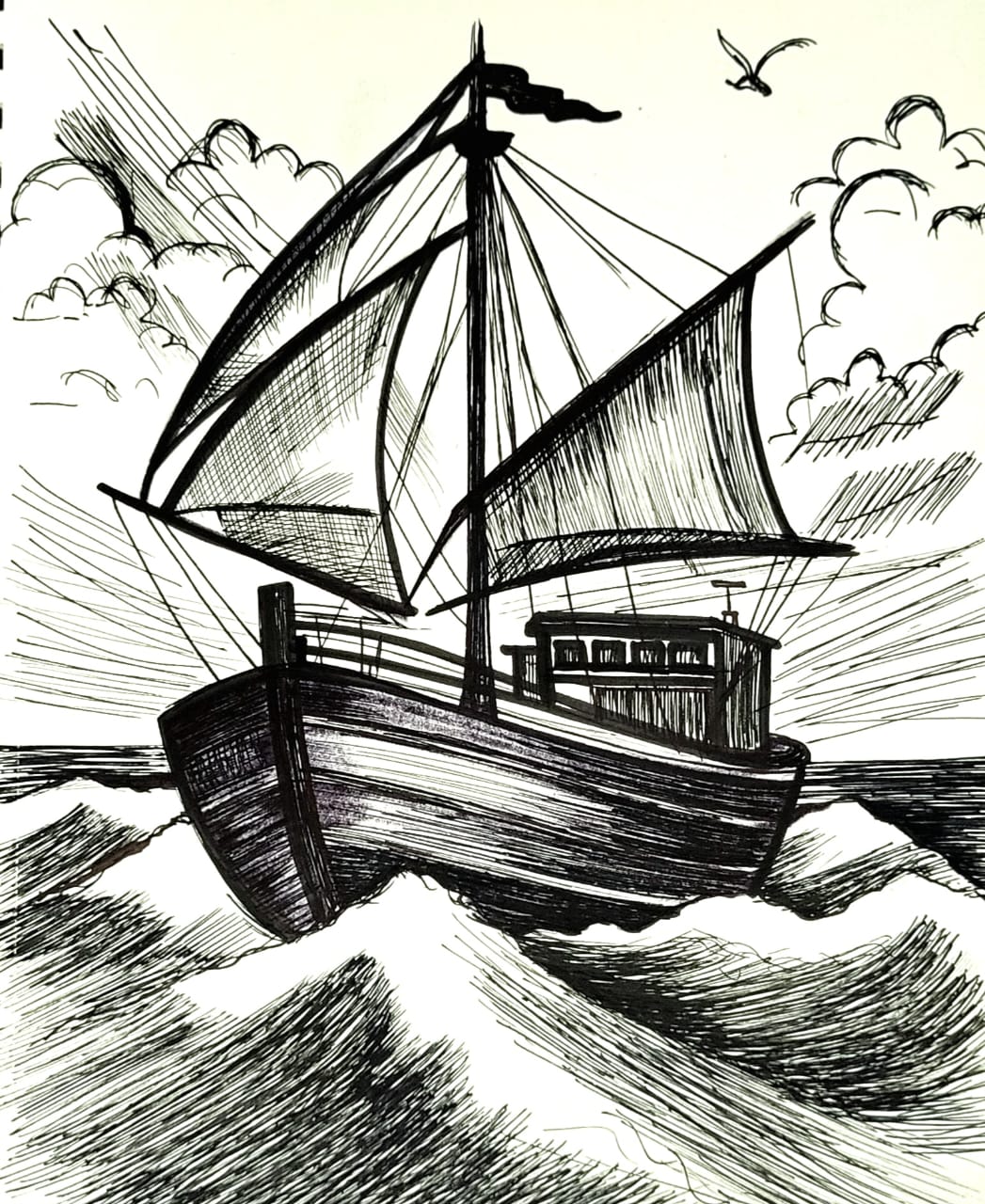
“When I think of Robinson Crusoe, I think not of a sunlit desert island but of a long, cold, corridor in boys’ school in which I am not allowed to run.” – Jack Robinson.
As a child, I always thought of Robinson Crusoe as a mere adventure story. It was the tale of a sailor who experienced a shipwreck and got stranded on a desolate island. However, an adult and mature reading of the text reveals something far more disturbing and controversial, especially in the present times. The novel is an allegorical representation of an imperialist venture and enterprise centred around a British sailor who becomes a master over an island and establishes it as his own personal colony.

Defoe’s Crusoe is infused with subtle and direct references to colonialism which was proving to be a booming enterprise for the colonizers at the time of the novel’s creation. Going abroad in these established colonies was increasingly beneficial for the ones who were less privileged in their home country. This middle or intermediate class came in high numbers to the colonies in India, Africa and Latin America to find economic opportunities. They found such great wealth in some of the places in India that they were able to raise a fortune and buy titles and lands for themselves in Britain. Robinson Crusoe came from this social class. Crusoe, who was neither aristocracy nor landed gentry, neither a soldier nor a crown agent found his status elevated due to his autonomous efforts. His authority on the island was a kind of monarchical system and a process to validate his self-image.
We first see the beginning of the colonial endeavor on his voyage to Guinea. Taken as a prisoner in Salle, a port belonging to the Moors, he escapes tactfully by tossing the Moor with him into the water, on the grounds that he is not worthy of his trust. This kind of treatment of a Moor is very much colonial. At the same time, Crusoe agrees to take Xury, a Moor boy, along with him because he knows English and vows to forsake his own religion and embrace Christianity, revealing Crusoe’s colonial frame of mind. Xury is here “the colonial other” who calls Crusoe his colonial master.
After all this is settled, Crusoe undertakes another journey which ends with him stranded on an island with no trace of civilization. The island seems untouched by humanity. It is in its pure and raw form. The presence of Crusoe brings ‘civilization’ on that island. This ‘civilization’ means that it will be dominated by the customs and beliefs of Robinson Crusoe. It is also notable that the true colonization only began when he found footprints on the island. The possibility of another humanly presence posed a threat to his control over the island. His colonist mindset did not allow him to rejoice over human companionship.
The true Colonial mission, however, is embodied in the form of Man Friday, a native turned humble servant after Crusoe saved his life from cannibals. After committing this heroic deed, Crusoe makes Friday his slave. Friday, himself pledges his lifelong loyalty towards Crusoe. On the surface, it seems logical. It is because Crusoe is in control of the narrative. We see Friday through the eyes of Crusoe. We only hear his voice when Crusoe translates it into his own tongue for the readers. He has no voice of his own.
Crusoe names Friday after the day on which he was ‘saved.’ The word ‘saved’ seems innocent enough but he did not ask Friday if he wanted a new name or even bothered to know about his past life. He named him after a thing rather than a person which only highlights the dehumanization of the colonist subjects. By giving him a new name, he gave him a new identity thereby erasing the trace of his past life, his previous family, his own culture, and his homeland. That is only if Crusoe believes Friday even had a culture before meeting him. Friday became the symbol of ‘white man’s burden,’ the Euro-centric notion that Europeans need to and have rights to make civilized natives out of uncivilized ones. Crusoe shows strong contempt over the fact that Friday has cannibalistic desires and forbids him to mention it ever again. He takes it upon himself to educate and civilize Friday. It was not so much the colonisation of the body that benefitted the colonial cause but the colonisation of the mind.
Crusoe wanted to convert Friday into a civil Christian slave. He taught him about Jesus Christ who was the true God and asked him to forget about Benamuckee, the mountain God of his tribe. Crusoe asks to be addressed as ‘Master’ and starts teaching him a few English words such as ‘yes’ and ‘no.’ He teaches him only those words which are useful for the master-slave relation and helpful to dependence not for protest. He calls himself Friday’s father and expresses keen jealousy over Friday’s joy at reuniting with his own father.
Crusoe’s power comes from his property as well as because of Friday’s lack of it. He has an assumed authority over the island. Crusoe’s imperial venture in the island becomes a success when Man Friday, so much colonized in and out, doesn’t even wish to go to his own country without him when the opportunity comes.
EM Forster described Defoe’s Crusoe as “an English book, and only the English could have accepted it as adult literature; comforted by the feeling that the life of adventure could be led by a man duller than themselves… boy scout material.”
Speaking in the post-colonial context, Crusoe should have never become a role model. He was a chauvinist who did not see any parallel between when he himself was made a slave and selling another human being to slavery.
What do you think of Robinson Crusoe? Let me know in the comments below.



Leave a Reply