
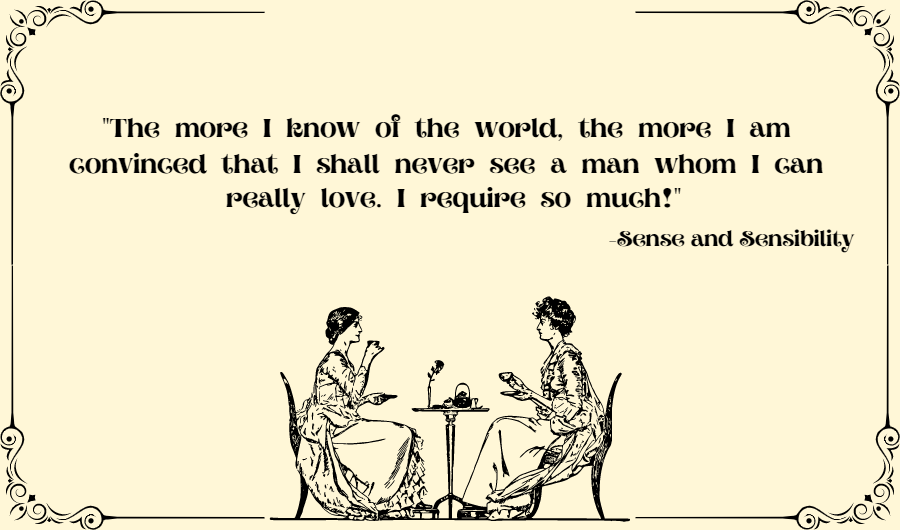

Like every other Austen novel, the siblings of Sense and Sensibility play a dominant role in resolving the emotional and interpersonal conflicts in the novel. Whether it is Pride and Prejudice, Mansfield Park or Sense and Sensibility itself, the relationship of the protagonist with her sibling becomes the yardstick with which every other relationship, be it romantic, is measured. Born and raised in the same families, taught the same values and moral ideals, these siblings can be poles apart in their personalities. The outcomes of these disagreements and differences of opinion then become the building block which forms the events of the novel. Depending upon each other for their emotional needs, they lean on other’s shoulder for hope when adversity strikes.
In Austen’s time, families were large and often the children were left to themselves without adult supervision. These arrangements produced a hierarchy in which the eldest of the siblings would assume a position of authority. In Sense and Sensibility, Elinor comes across as a figure in charge in the Dashwood household as neither her mother nor her younger sister, Marianne are capable to do so. In fact, their mother acts like a sister rather than a parental figure, more to Marianne than to Elinor. However, Elinor, and Marianne’s sororal bond overshadows even the romantic attachments they form. Their sisterly bond brings the ingredient of melodrama to the novel.
Elinor is pragmatic with sense of judgement, prudence and decency while Marianne, the ‘prima donna’ of all her emotions is a romantic with no control on her emotional excess. Her prudence does not allow her feelings to be expressed as boisterously as her sister’s even if she has a whirlwind of emotions inside her. When Edward leaves Norland to visit Barton Park, Elinor is uncomfortable but does not show it. Marianne, on the other hand, wears her heart on her sleeve and expresses herself in a candid manner. She cannot comprehend how her sister can remain so reserved and calm. She judges the character of people by the way their actions or reactions to a particular situation are making ‘her’ feel or whether their idea of something that she admires coincides with hers. That is why, Edward’s reading of Cowper does not charm Marianne. She considers it ‘tame’ and ‘spiritless’ for her taste. She unequivocally declares that Edward has no real taste of art.
Despite these differences, these sisters have an understanding like no one and it is only their way of thinking and perceiving the world that sets them apart. When Elinor confronts Marianne about the letter that she is so eager to receive from Willoughby but she will tell her nothing, so Elinor argues the she will not confide in her. To this, Marianne retorts by declaring, “Our situations then are alike. We have neither of us any thing to tell; you, because you do not communicate, and I, because I conceal nothing.” This brings out the slightly didactic nature of this novel.
A transformation of their personalities is seen when Willoughby confesses his faults to Elinor. Elinor cannot help but be empathetic and accept his apology and deem his regard for her sister to be true. Elinor is convinced after all that Willoughby is not so guilty and vile. However, Marianne is only content that she has this information. Another instance is when Elinor finally accepts that she has been in agony in the past few months because Edward is engaged to Lucy Steele.
Their third sister, Margaret Dashwood does not become a member of the sorority that her sisters have formed. When Elinor is “attacked” by Mrs. Jennings to reveal the name of her beau, Margaret jumps in and asks whether or not she should reveal the name, which causes further embarrassment to her sister.
John Dashwood plays negligent, but an intrusive role in his half-sisters’ lives. His failure to provide for them after their father’s death is what drives them to procure a cottage, their quiet and secure life is uprooted and they are thrown into an unpredictable position. In spite of all this, Elinor and Marianne emerge as more resilient and assertive than their past selves ever were.
In contrast to this duo, there are the Steele sisters. Anne and Lucy Steele, although constantly striving for societal approval, do not charm Elinor who views them to be unprincipled and inelegant in their personalities. Without any parental supervision, they engage with the outside world for the sole purpose of finding a husband and thereby, securing their future. Elinor sees them for who they really are. Being uneducated and with no dowry, they seek the consent of society and want conventional happiness. Anne Steele, who always has to be in her sister’s shadow wants to be socially elevated, keeps talking about beaux and wants to attract the fancy of a ‘Dr. Davis’, who is oblivious of her attraction to him. Lucy governs her less beautiful sister who depends on her to achieve distinction in society.

These sisters are almost similar to each other with little differences in their personalities. They can be selfish and deceitful to the people they consider their competition. However, they are more knowledgeable about the ways of the real world and pragmatic than Elinor herself. That is why, it is easy for Lucy to shift her affections from Edward to Robert when their mother’s favour shifts to the younger son, than it is for Elinor, even when she knows that marrying Edward may not guarantee her the luxury that a woman of her social class is expected to have. When Anne reveals to Fanny that Lucy has been engaged to Edward for all these years, she earns the contempt of her sister, but they soon make up. They might not be the ideal sisters, nevertheless, they have that sisterly love, that Austen so dearly instils in her heroines.
Then there are the Ferrars. The Ferrars brothers, Edward and Robert do not seem to have any brotherly affection. Their personalities are not even remotely alike and each has a very different way of perceiving things, be it in personal relationships or in worldly affairs. Robert’s manners do not at all appeal to the people he interacts with. Lucy Steels describes him very much unlike his brother. She calls him “silly and a great coxcomb.” Robert is vain and is a dandy. He only gains his mother’s attention and inheritance because his brother loses it. Unlike his brother, Edward is all about honour and duty. He knows he loves Elinor and not Lucy, still he continues to bind himself with their four yearlong engagement. This will raise him in the eyes of people like Mrs. Jennings but will not bring him the personal happiness that he desires.
Edward wins over the reader through his principles and values that he so staunchly upholds while Robert does not care as he knows he has the advantage of good fortune and his mother’s favour. Nevertheless, they share an understanding. Robert knows that Edward should not have been sent away to continue his education at Mr. Pratt’s while Edward knows how his brother and Lucy Steele got in each other’s good books. In contrast to the sisters, these brothers do not care about their looks as all that matters is who has good education and possesses the family riches. Their sister, Mrs. Fanny Dashwood is more like her brother Robert than Edward. She is self-centred, vain and a snob. She does not have her brothers’ best interests at heart. She doesn’t want Elinor to marry Edward just because she has no inheritance despite manipulating her husband to do so.
Mrs. Jennings’ two daughters, Lady Middleton and Charlotte Palmer are no exception. Lady Middleton, due to her intrinsic nature, does not meddle much in the matters concerning others as her sister, Charlotte Palmer does. All Lady Middleton concerns herself with is the flattery of her children, herself and the way she manages everything in her household. Her immediate liking to Mrs. Fanny Dashwood reveals a lot about her character. In contrast to her sister, Charlotte Palmer pays her special attention to everything that goes on in the lives of the people around her. Both are only united by the fact that they share the same social status and that both their husbands have personalities quite dissimilar to their own.
There is yet another pair of siblings that almost goes unnoticed. Unlike Edward and Robert, the relationship of Colonel Brandon and his brother is filled with enmity and hate due to his brother’s mistreatment of Miss Williams. They never get to experience any special bond between themselves like the rest of the siblings do.
The novel’s sibling mania can be established by the single fact that The Dashwood family only came to live at Norland because the house owner’s ‘sister’ who was his “constant companion and housekeeper” had died. It was his need to trying to fill that gap that started the events of this novel in the first place.
Comment your thoughts below.


Leave a Reply