
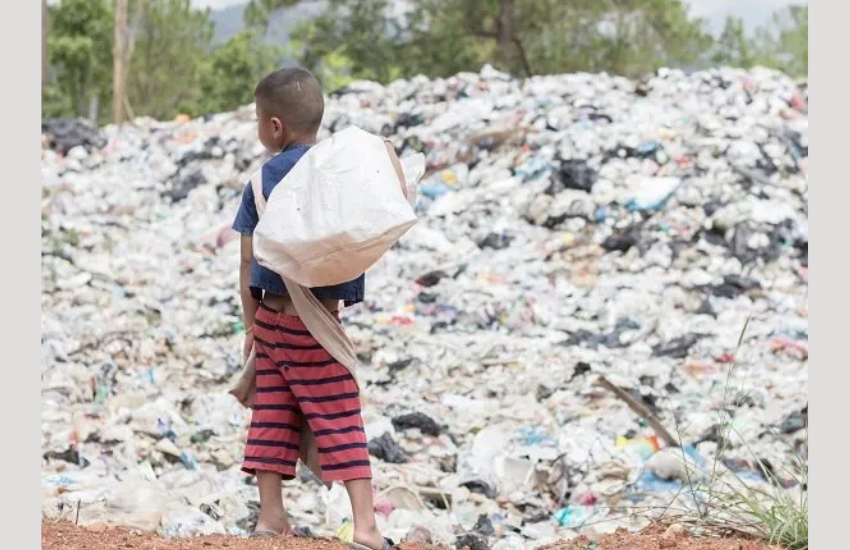
Anees Jung is a renowned Indian author and journalist known for her insightful writings on social issues, especially those affecting women and children. Her work often reflects deep empathy and a commitment to social change. In Lost Spring: Stories of Stolen Childhood, she sheds light on the lives of impoverished children forced into labor. Through real-life accounts, Jung exposes the injustices of child exploitation and emphasizes the importance of education and societal responsibility in shaping their future.
Context- The chapter is divided into two parts giving an account of the lives of the underprivileged and the working class. Her aim is to spark societal empathy and advocate for children’s right to education, dignity, and a better future.
Summary- ‘Sometimes I find a rupee in the garbage’

The narrator tells the story of Saheb, a ragpicker in her neighbourhood who looks for gold in the garbage dumps. He, like many others in his locality left his home in Dhaka a long time ago. He cannot go to school because there is no school in his neighbourhood. But he says when they build a school, he will go. His full name is Saheb-e-Alam, meaning the lord of the universe, which the narrator finds ironic given his condition and impoverishment. When asked why Saheb and his friends roam barefoot and not wear chappals or shoes, they give mixed answers. The narrator wonders whether the tradition to remain barefoot is only an excuse to explain a perpetual state of poverty. She remembers a story a man from Udipi told her once. He was the son of a priest and used to pray for a pair of shoes at the temple. Thirty years later, she visited his town and saw that the son of the new priest is wearing shoes. The ragpickers, however still remain shoeless.
The ragpickers live in Seemapuri, situated on the periphery of Delhi. Like Saheb’s family, those who live here are squatters from Bangladesh who came in 1971. Around 10,000 ragpickers live there devoid of basic amenities and without an identity. But for the people, food is more important than identity and wherever they find food, they pitch their tents. Ragpicking is a means of survival and for them, garbage is gold. Sometimes Saheb finds a rupee or even a ten-rupee note. Then there is hope of finding more. One morning, the narrator sees Saheb watching a game of tennis from behind the fence. The gatekeeper, sometimes lets him use the swings. He is also wearing the discarded tennis shoes of some rich boy because one of them has a hole. The game, however remains out of his reach. Soon, Saheb started working on a tea stall and was paid 800 rupees and all his meals. However, the steel canister he now carries is than his plastic bag. The bag was his but the canister belongs to his master. He is no longer his own master.
Difficult word-meanings-
- Scrounging- to get things by asking or searching for them
- Glibly- speaking in a confident way but lacking clear thought
- Bleak- a place that is depressing and without hope
- Perpetual state- a condition that never ends or changes
- Desolation- great unhappiness
- Ragpickers- a person who collects waste material from the streets for livelihood
- Periphery- outside the boundary
- Metaphorically- not in a literal sense
- Squatter- someone who illegally occupies unused land
- Tattered saris- old and torn saris
- Transit homes- temporary living space who enter the country illegally
‘I want to drive a car’

The second story follows Mukesh who wants to be a motor mechanic. His town is Firozabad where every other family is engaged in bangle-making. Mukesh’s family is one of them. The children of the families work in dangerous conditions in the dark and no one knows that it is illegal for children to work in such conditions. Mukesh proudly tells the narrator that his house is being rebuilt. The area around his house is severely underdeveloped. His house has thatched roof and sister-in-law is cooking the meal for the whole family. Mukesh’s father is an impoverished bangle maker who has only managed to teach his sons the art of making bangles. His grandmother believes it is Mukesh’s destiny and this god-given lineage cannot be broken. The children who make bangles with their parents often lose their eye-sights before reaching adulthood.
The narrator watches a young girl, Savita making bangles and wonders if she knows what they symbolise. She says she will know when she becomes a bride. The old woman sitting beside her has not even had a full meal in her lifetime. Her husband knows nothing except bangles but he has managed to put a roof over his head. Time has changed and lack of money has killed their ability to dream. When the narrator asks them to form a cooperative to remove the middlemen, they reply that even then they will be the ones to go to jail for doing something illegal. There is no leader among them. The narrator sees two worlds- one of the family caught in caste divisions and the other of the middlemen, politicians etc. Both of them do not allow the child to dare. But in Mukesh, there is hope of being a motor-mechanic. However, he does not want to fly planes because he has seen cars pass on the road but few planes fly over Firozabad.
Difficult word-meanings-
- Mirage– an unrealistic hope or wish that cannot be fulfilled
- Dingy– dark and dirty
- Slog- working hard for a long period
- Wobbly doors- unstable doors that move from side to side
- A primeval state- a simple or raw state that existed at the beginning of time
- Thatched- a roof made from straw (dried crops)
- Frail- weak and delicate
- Veil- a covering to hide the face
- Lineage- it refers to one’s ancestors: parents, grandparents and so on.
- Unkempt- untidy and not cared for
- Shanty- small and rough shelter
- Drab- dull and lacking brightness
- Soldering- a process of joining two metal surfaces
- Tongs- a tool used to lift objects
- Sanctity- the quality of being holy or sacred
- Apathy- lack of interest or concern
- Stigma- a mark of disgrace associated with a quality or person
Themes-
- Loss of Childhood Innocence- Saheb and Mukesh work as ragpickers and bangle-makers instead of going to school. Burdened with responsibilities, they lose their carefree days, and the joy of youth is replaced by the struggle for survival.
- Poverty- Poverty has trapped generations in hardship. Saheb’s family survives by ragpicking, while Mukesh’s works in the hazardous bangle industry. Lack of education, poor living conditions, and limited opportunities force them into labour, making poverty both the cause and result of their lifelong struggles.
- Social Inequality- The narrator exposes social inequality through the lives of Saheb and Mukesh. Despite laws and resources, the poor remain deprived of education, health, and dignity, while the privileged live comfortably. This unjust gap keeps the underprivileged trapped in a continuous cycle of exploitation and deprivation.
- Government and Social Neglect- The narrator criticises government and social neglect that allow child labour and poverty to persist. Despite existing laws, children like Saheb and Mukesh lack education, safety, and opportunities. Indifference from authorities and society keeps them trapped in hardship, with little hope for real change.
Hey there students! Here’s a CBSE Previous Year Question for you:
Q. What vicious circle are the bangle-makers trapped in? (2 marks)
Answer in 40-50 words:
You can write your answers in the comment section. I will provide feedback to each of them.
Leave a Reply