
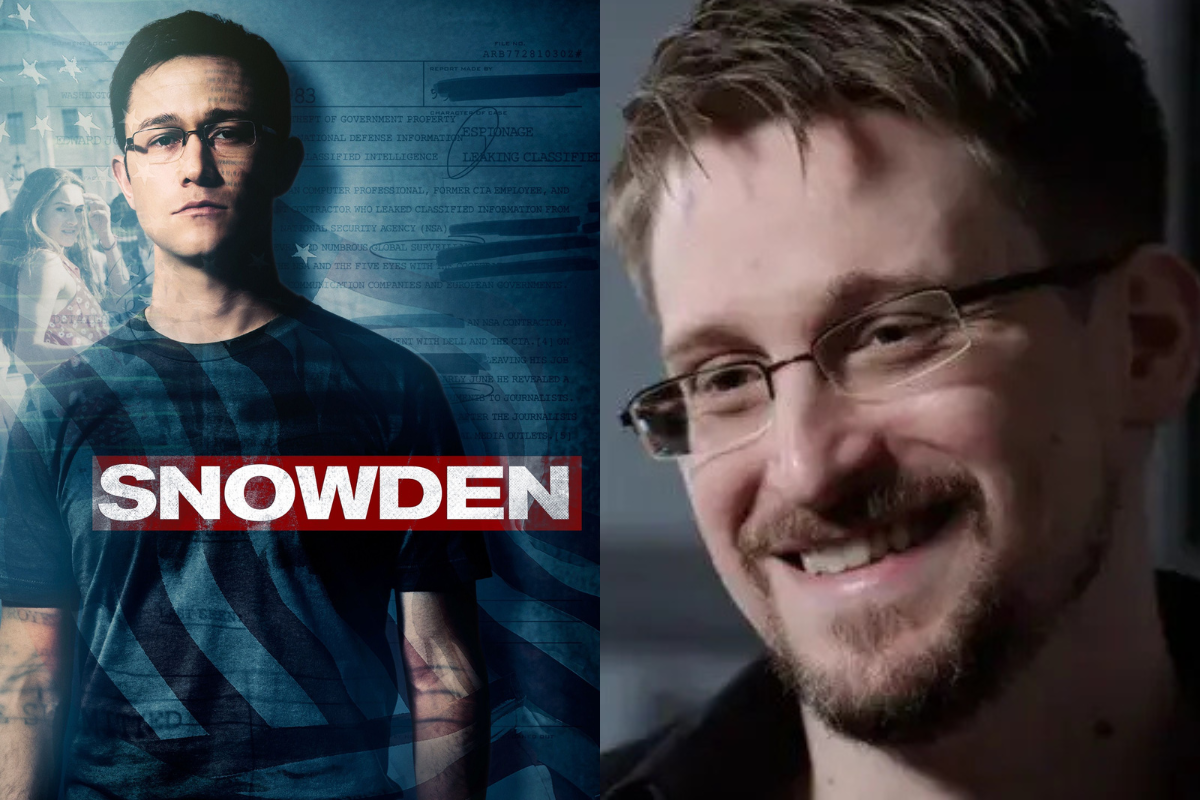

A few days ago, I watched the movie ‘Snowden’ on Netflix. It is a 2016 film starring Joseph Gordon-Levitt and Shailene Woodley in the lead roles. It’s not only based on a true story but is a dramatization of real events. Edward Snowden was a US intelligence analyst, who became a whistleblower and fugitive by leaking classified documents about America’s spying and mass surveillance programmes. The film prompts the viewer to ask questions, to beware and be sceptical. ‘They are always watching.’ We follow Snowden’s footsteps, personal and professional, that force us to question whether we would have the strength and courage to do what he did. Maybe, ‘Snowden’ did not provide a solution to the problem, but it certainly started a conversation. A conversation that still continues on…

This Oliver Stone film was definitely a propaganda in support of privacy as a human right. From enigma machines to webcams, it raises the suspicions that perhaps the whole purpose behind these machines and gadgets was spying all along. The next war will not be fought with weapons and ammunition, but with rogue computer worms and malware. The image of an armed, shielded soldier would be replaced with a geeky computer genius.
The narrative of the movie is pretty convincing. Ed Snowden had everything to lose and nothing to gain. He left behind a high paying job, a loving relationship with his girlfriend, Lindsay Mills, with little hope of getting it back when he fled the USA under the threat of being charged with the Espionage Act.
The concept of mass surveillance brought to light in the movie is not a 21st century concept and concern. The English philosopher and social theorist, Jeremy Bentham published his work ‘Panopticon’ in 1791. It was a theoretical concept of an all-seeing prison. In the centre of a circular building will be erected a watchtower where a single guard would be stationed. It was a one-way surveillance method as the doorless cells were built so the inmates could not see each other but only the watchtower. They were under constant observation. At least that’s what they felt. There was no way of knowing when they were being watched. The theory provided an efficient system of control and discipline that was not limited to prisons. Several real-world prisons were inspired by this idea like Stateville Correctional Centre (Illinois), Pentonville Prison (London) and Eastern State Penitentiary (Philadelphia).

Michel Foucault, the French philosopher, wrote about Panopticon in his 1975 book ‘Discipline and Punish.’ He used it as a metaphor for modern disciplinary societies arguing that the Panopticon exemplified how power operates in modern institutions through surveillance and control.
This highlights that in order for anyone to gain control and establish dominance, they have to know everything. The state needs to know the details of every single individual.
Rather than restricting your body or physicality, a panopticon restricts your mind. It is a prison of the mind. Unable to deduce when you are being watched induces anxiety and paranoia. The surveillance becomes a tool of oppression. In contemporary digital age, individuals have little to no privacy. There is only the impression of privacy. In the name of national security and prevention of crimes, governmental authorities are able to store and collect tons of data from individuals.
This concept can also be found in fantasy and fiction. In J.R.R. Tolkien’s ‘The Lord of the Rings trilogy,’ The Eye of Sauron is a key symbol that represents the dark power and ever-watchful presence of Sauron, the Dark Lord of Mordor. It is an enormous, fiery, lidless eye, constantly searching for the One Ring demonstrating the dark lord’s ability to spy and influence events across Middle-earth.

Published in 1920, Yevgeny Zamyatin’s dystopian novel ‘We’ depicts a society of mass surveillance in which all the houses and buildings are made of transparent glass as the citizens should have nothing to hide from the government. The state mandates the daily schedule for activities, work, and even personal time. Everything from sleep to sexual encounters are overseen by the government. The reason is to suppress and detect any hint of rebellion.

George Orwell was highly influenced by this work. The influence can be seen in his own dystopian novel ‘1984.’ ‘Big Brother’ becomes the symbol of oppression and omnipresent surveillance through the use of two-way telescreens and Thought Police. Any originality or individualism is forbidden and is rigid to the extent that even a twitch or unconscious facial expression might betray a lack of loyalty to Big Brother.
In Samuel Butler’s ‘Erewhon’ published in 1872, a more subtle approach is taken towards populace control and surveillance as compared to 1984. In this world, illness is treated as a crime and machines are outlawed since they will evolve and surpass human intelligence.
One characteristic that is common to all these narratives and dominating societies is fear. Through punishments or threats, a fear is instilled in the citizens and becomes a means of subjugation. This fear is usually created out of non-existent and hollow concerns which are too believable to the people.
Winston Smith of 1984, when captured was forced to face his worst fear: rats. And how did they get this information? By monitoring his every single day of his life. Unless he give out the information they needed, or a cage will be put on his face containing rats. Rats that gnaw at him and tear his flesh. They succeeded. He broke. His psychological defeat destroyed the rebel in him.

The surveillance tactics shown in ‘Snowden’ are frightening and alarming. The scariest part is that it was not a fiction or dystopia. It was reality. It was the truth about the world we live in. Some view him as a hero who defended civil rights and transparency while others call him a traitor for exposing national secrets and confidential information.
But the real question is that are we comfortable with leading our lives in public? Will loss of privacy become the new normal or has it already? What is your opinion? Tell us in the comments. Do you think we are living in a state of mass surveillance or do we still have the ropes in our hands, however delicate the threads may be?



Leave a Reply