
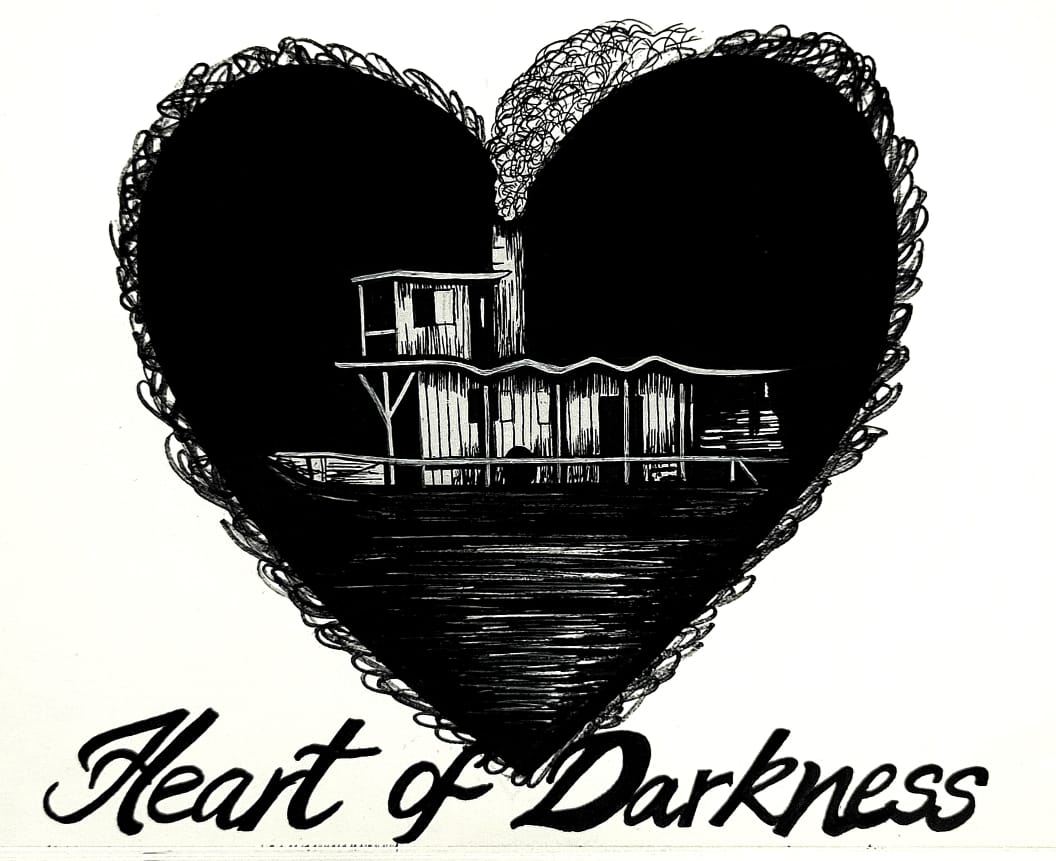

Heart of Darkness needs little introduction. Published in 1899 by Polish-British author Joseph Conrad, the deeply unsettling story has captured the imagination of readers, filmmakers and game-designers for over one-hundred years.
Set in the chaos and depravity of the Belgian Congo, the novella follows a man named Marlow as he travels up the Congo River, at the behest of an ill-defined colonial corporation, in search of the elusive Mr. Kurtz.
Heart of Darkness remains a controversial book. Many, including famed Nigerian author Chinua Achebe, have criticized Conrad’s depiction of Africa and native Africans labelling it as ill-informed and offensive. In fact, my own university presented Heart of Darkness as an outdated work of colonial literature which was worth acknowledging only in passing.
Yet, viewing Heart of Darkness strictly as a work of colonial and imperial fiction is, in my opinion, insufficient. When it was originally written in the late 19th century, Conrad used the setting of the novel to illustrate something far more fundamental, an idea which has outlasted the colonial context of the original text:
“Who is the man at the end of the river?”
While Conrad’s depictions of Africa are problematic, the novella uses its setting as a framework to explore ideas which transcend the age of Imperialism. Heart of Darkness is not a novel about colonialism. It is a novel about human psychology and the fascination we, as human beings, have with understanding the nature of violence, destruction and evil. The clearest indication of this can be found in the fact that the basic story of Heart of Darkness can be used in almost any setting and the core idea still remains intact.
The film ‘Apocalypse Now’ transplants the story from the Belgian Congo to the Vietnam War and follows a special forces soldier as he travels a conflict-ridden land in search of a rouge American Colonel. Similarly, the 2012 video game ‘Spec Ops: The Line’ chronicles the journey of a Delta Force operative named Walker as he explores a post-apocalyptic Dubai in search of his former commanding officer. Both stories use the same basic premise of Heart of Darkness:

“An agent of a nebulous organization enters a dangerous foreign location with orders to locate an authority figure who seems to be linked with the violence of the situation.”

And like Heart of Darkness, both Apocalypse Now and Spec Ops: The Line depict the strife which plagues the main character as they descend further into the madness of their environment in search of the answer to the question:
“Who is the man at the end of the river?”
The ‘river’ of Heart of Darkness is not merely a body of water, it is the vehicle which brings the protagonist ever closer to the answer they seek. And every stop along the river presents the main character with a fresh and incomprehensible horror. Whether it be the casual cruelty of colonial bureaucracy; or the psychedelic insanity of a helicopter raid; or the terrifying effects of chemical weapons, the river flows only onwards and once the journey begins, the only conclusion lies with the figure at the end.
One of the most interesting aspects of the story of Heart of Darkness, Apocalypse Now, and Spec Ops: The Line is that there is almost nothing physical preventing the main character from abandoning their quest and escaping the danger which surrounds them. Instead, the characters march onwards because their personal need for answers trumps any consideration of their own safety or the safety of others. They prioritize their confrontation with this figure above all else. Why?
Because, the river represents more than just a waterway, Kurtz represents more than just a sadistic ivory merchant. Kurtz has a deeper level of knowledge about the situation which the protagonist cannot comprehend. Kurtz knows a horrible truth which guides his thinking. Kurtz’s actions are not simply random violence but are rooted in some hideous clarity of purpose. The protagonist believes that a single man lies at the end of the violence and the bloodshed and that this man has access to a piece of forbidden knowledge which provides meaning to the horrors, seen and committed.
The protagonist in Heart of Darkness, and its adaptations, are so bent on extracting rationale from a seemingly random and irrational situation that they go to great lengths to obtain the answers they seek. By the end of the journey, the protagonist is almost unrecognizable from the man they were prior to the story. Marlow is rendered delirious and near death by malaria; Willard transforms into a prophet in war paint; and Walker is hideously scarred by burns and bullets.
And yet, in each case, the promise of answers is ultimately a lie. The man at the end of the river either does not have access to the secret truth the protagonist seeks or will not share this forbidden knowledge with them. The man becomes an item, an obsession, a vessel for all of the protagonist’s doubts and uncertainties.

In each story, the confrontation between the protagonist and the man at the end of the river plays out in a different yet equally fascinating manner.
Marlow finds Kurtz bedridden, babbling and on the brink of death. Marlow questions Kurtz about the atrocities taking place throughout the Congo. But Kurtz dies before he can provide any real answers. His last words are a terrified realization of the horror which mankind has manifested in the world.
Willard is imprisoned and lectured by the Colonel on his disdain for those who adhere to something as meaningless as a code-of-conduct to govern something as barbaric as a war. The colonel expresses his admiration for those who abandon their humanity in order to carry out vicious acts without hesitation or remorse. Willard murders the colonel but it’s unclear as to whether he accepts or rejects the Colonel’s poisoned gospel.
Though, it is Captain Walker from Spec Ops: The Line who has the most impactful confrontation with the ‘antagonist’ of the story. Throughout the game, Walker and his special forces team decimate Dubai. First killing insurgents, then gunning down rogue American soldiers, and eventually the massacre of innocent civilians. Walker’s mental state gradually unravels as he places the blame for the heinous situation on the voice of Konrad, the commander of the American forces, who speaks to him from the other end of a radio. After butchering legions of his fellow man Walker finally confronts ‘Konrad’ only to find that the man he held responsible for the bloodshed died weeks ago and that Walker has no one to blame for the atrocities but himself.
In each story, the protagonist’s search for answers is ultimately their undoing. There is no singular force which can be easily blamed for the horror which surrounds them and by continuing on their quest they are, at best, forever scarred by the experience or, at worst, actively make the situation worse when their attempts to help constantly backfire.
The question which remains is; if these stories are so bleak and miserable, then why seek them out to experience them? The story of the quest for the man at the end of the river has no good outcome and yet, the story is compelling all the same. We as the reader/ watcher/ player are also on a quest for answers alongside the protagonist. We also want to know what secrets Kurtz harbours. The protagonist verbalizes the questions which we want asked, even if we don’t want to hear the answers.
In this way, Heart of Darkness is not just a novel about colonialism. It is a story about the lengths we will go to in order to make sense of the senseless. It’s about how we try and rationalize the casual evil of a monolithic system as being linked to the deeds of one man. It’s about how we try and recognize a human hand in acts which are utterly devoid of humanity.
In closing, I think that it is fitting to return to Chinua Achebe and his criticisms of the original novella. Achebe viewed Heart of Darkness as a novel of an outdated age which expressed outdated opinions.
Yet, his own works touch on the themes of the story and the struggle to comprehend the depravity which mankind is capable of. His poem ‘Vultures’ compares the similarities between a pair of savannah scavengers and the commandant of a nazi concentration camp. Despite being disgusting in appearance and in deed, Achebe highlights how even creatures which commit such wicked acts are capable of feeling and expressing love. But if it is true that those who are immersed in evil can display love then the reverse must be equally valid:
for in every germ
of that kindred love is
lodged the perpetuity of evil.
As long as humankind persists, so too will the perpetuity of evil and so too will our quest to understand this evil by confronting the man at the end of the river.
What is your view of Conrad’s ‘Heart of Darkness’? Do you think it is an outdated novel or does it still hold relevance? Let us know your opinions in the comments below.


Leave a Reply