
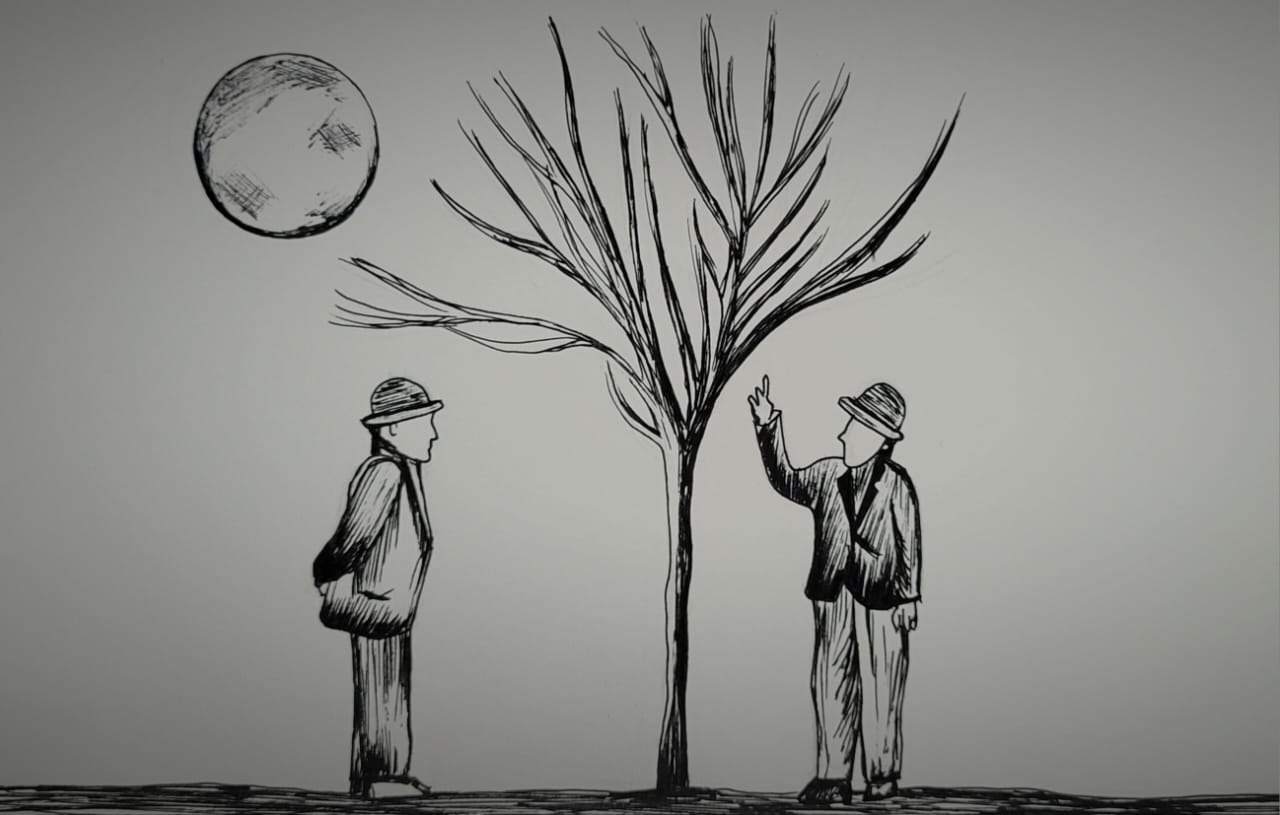
“Art has nothing to do with clarity, does not dabble in the clear and does not make clear.”- Samuel Beckett.

I believe being different is a characteristic that has belonged to every writer that has ever made a name in literature. Samuel Beckett has somehow managed to be different and original at the same time. ‘Waiting for Godot’ is a tragicomic play in the absurdist tradition that explores existentialism. Written almost a century ago, the play continues to be relevant. You will find numerous references of the play in popular culture. But why does it still continue to attract readers and viewers alike is a question to explore.
The play is about two men Valdimir (Didi) and Estragon (Gogo), who are waiting beside a tree for someone called Godot. It’s a two act play and Godot appears in neither of them. Who is Godot? Why are they waiting for Godot? Will Godot ever come? These questions remain unanswered in the play. While they are busy waiting for him, we meet two other characters named Pozzo and Lucky. Lucky is Pozzo’s slave. Pozzo keeps berating Lucky who like a dimwit stands their doing nothing. Their presence does not make sense. Nothing makes sense in the play. It is like abstract art. It exists for the sake of itself.
Vladimir and Estragon are clueless. They are not sure if Godot will ever come but still they keep waiting. They engage in conversation and give the readers some hard-hitting lines such as ‘People are bloody ignorant apes,’ ‘Don’t let’s do anything. It’s safer,’ ‘Nothing happens, nobody comes, nobody goes, it’s awful.’ Exactly who or what Pozzo is, is also not made clear. He is going somewhere with Lucky, who is carrying a load of bags which he never puts down. When he does put down the bags, he gives a speech that sounds like when you let your keyboard finish the sentence. Except it’s two pages long. Then comes a boy who informs them that Godot won’t see them today again but he will come tomorrow. It makes you wonder if it’s a daily occurrence and they are stuck in a loop. The same happens the next day in Act 2. Godot never comes yet they don’t move.
Godot’s meaning and existence is a much-debated topic. The most popular theory is that it means God as in (God)ot. But Beckett originally wrote the play in French, in which the word for God is ‘Dieu.’ Beckett himself has commented on the topic ‘If by Godot I had meant God, I would have said God, and not Godot.’ The only thing Beckett was sure of in the play was that all of them were wearing bowler hats.

So Godot is not God. Others claim he is death yet others view him as the ‘act of waiting’ itself. There are several theories and each one seems correct. That was Beckett’s point. He believed in ambiguity as art can never be clear. True art is open to interpretation. Pozzo does not want to leave. He says ‘I don’t seem to be able to……. depart.’ Estragon replies ‘Such is life.’ We don’t know what to do when we are here but we also don’t want to leave.
Besides, aren’t we all waiting for something? Something better to come along. In the meantime, we are only passing time. Pozzo and Lucky helped Vladimir and Estragon pass the time. They were a distraction in their eternal wait of Godot. But as Estragon points out ‘It would have passed in any case.’ Vladimir has the best response ‘Yes, but not so rapidly.’
So we are all just passing the time with occasional distractions in our way. But what are we waiting for? Godot? It seems like it. We don’t how long will we have to wait? Will the wait ever be over? What will happen when it does happen? How will we react? We know we are waiting for something but it remains unclear and we are unsure as ever.
When the boy informs them that Godot is not coming, Vladimir insists that the boy tell Godot that he saw them. Why did he say that? It is the human need for acknowledgement, to have the satisfaction that someone knows about us. We matter. Our existence matters. We are not here without purpose. We won’t be obliviated.
On the first reading, I was dumbstruck by the play. The characters jump from one topic to another leaving the conversation in the middle which is a bit frustrating. But doesn’t that tell us about the human need for closure? We all want to see the end of everything. The end of a movie, of a play and even of life because even ending provides a sense of comfort. That comfort is denied to the readers of this play. It carries on like an itch that wouldn’t soothe. It’s uncomfortable, disorienting and repetitive. It’s perfect. It’s Beckett. It’s all of us.
The reason it will continue to resonate with more and more people because this play let the readers breathe, it let them be distracted, let them ask questions, let them be foolish just like the characters. It gave them a moment of rest in the fast-pacing life.
This play compares to those written by Shakespeare. Like Shakespeare, it shares universal themes. As Shakespeare’s plays are adapted comfortably in multiple contexts, so is Waiting for Godot. It’s adaptability is one of the reasons it continues to be performed in theatres worldwide.
What do you think about this play? Do you think it is relevant or overrated? Let me know in the comments.



Leave a Reply