
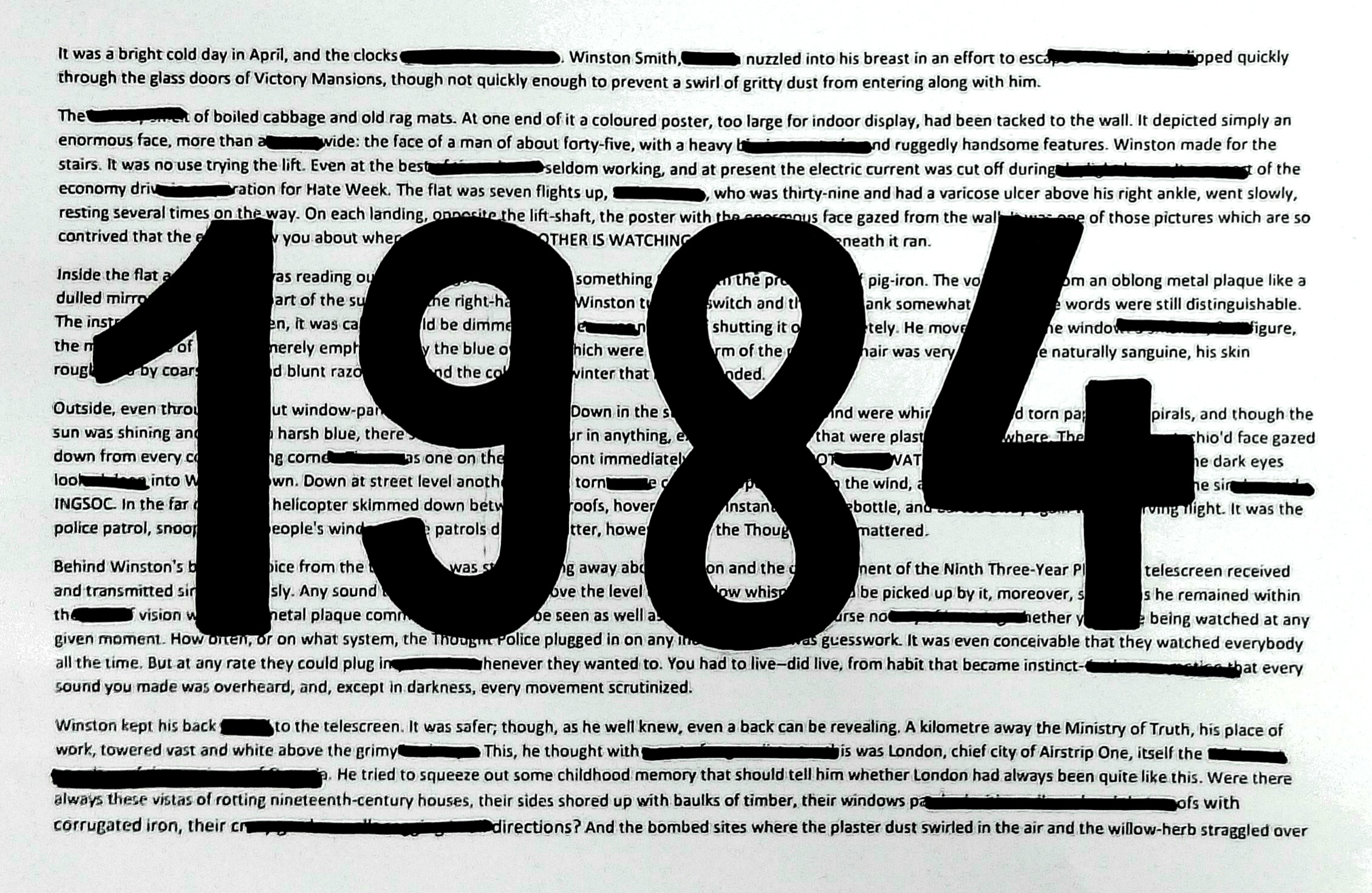
In the world of 1984, totalitarianism is in its full glory. Mass surveillance of the citizens, a total autonomy of the government with resistance being fatal is how the day gets by in Oceania. Just reading it makes you feel frustrated, angry and anxious. It’s the kind of place where artists would commit suicide and any thought, imagination or creativity would be murdered in its cradle. You are not allowed to love anyone (not even your children) or hope for something. Only the torturous reality of the Inner Party and Big Brother prevails. Winston, the anti-hero is a ray of sunshine in this pit of darkness. This sunshine finds a torchlight in the form of Julia. The two begin a secret love affair that gives hope to the readers of 1984 of a Partyless future. But soon, the reality catches up with them and their siesta is broken in a place where there is no darkness.

The Act of Love– In the words of Orwell, the union of Winston and Julia was a political act. Their love was an act of rebellion against the party and the spark that ignited this fire was the note that Julia gave to Winston that said ‘I love you’. Winston caught love sickness after that. He got a new hope for life. He couldn’t stop thinking about the dark haired girl. He began to care about the world and himself and looking forward to meet Julia. It made him feel alive again, something that he did not experience with his estranged wife. This illegal love affair was carried on in several places, the most important being Mr. Charrington’s room above the antique shop where it met its end. This is not just an act of love. It is a symbol of humanity and the fact that after taking so much from its citizens, the Party could not take away the power of one human being to feel love for another human being. During his torture at the Ministry of Love, Winston admits and O’Brien acknowledges that he has not yet given up Julia which makes him separate from everyone around him. All things aside, we still don’t know if Julia was an agent of the Thought Police that Winston thought her to be in the beginning. If it turned out to be true, the world will truly be doomed.
Hope– Hope is a mysterious thing. When you have hope but nothing else, the world still seems alright. But if you have everything else except hope, your world is bound to collapse one way or another. Winston hopes for a better future, for the defeat of the Party and for the old days to come back, although he does not remember what they were. His hope is crushed when O’Brien assures him that posterity will not remember him and that he will be forgotten after he beomes one of them. Winston’s courage falters and he gives in to his fears. Winston could not be called a strong messenger for hope. He was indeed a victim, just not an innocent one. The readers can still hope that in future, someone stronger than Winston will arise and bring down the Party. On a more factual note, the existence of the Appendix leaves the reader curious about the fate of Oceania. Why was there a need for the Appendix in a fictional novel? Why is it written in the past tense? Who wrote it? Why is it written in Oldspeak? None of the answers are clear or definite. The past tense points out to the possibility that the Party could not survive and someone from the future is writing about what happened at that time. Maybe Winston would be remembered after all.
Torture– The Party has its ways of making people submit to its will. Subjective torture is the Party weapon. Everyone is given a very specific kind of torture with something they are deathly afraid of. For Winston, it happened to be rats. Carnivorous, flesh eating rats that will chew his face off on being let out of the cage. This becomes the coup the grace to Winston’s resistance. All his sense of rebellion vanishes away and he gives in and begs them to do it to Julia. It works. He becomes one of them. Betraying Julia meant losing his individuality. Several studies have questioned the effectiveness of such torture and forced confessions. Despite his transformation, Winston did not truly believe what he said during his torture. He only said what he said to stop the excruciating torture. As stated in Part III Ch 2 of the novel ‘His sole concern was to find out what they wanted him to confess, and then confess it quickly, before the bullying started anew.’ Maybe it will be reversed with the passage of time when the effects of torture would slowly die down.

The most dreaded thing that comes to the reader’s mind is if we are indeed living in the world of 1984. Well, if you are reading 1984, you are not living in the world of 1984. In fact, you are nowhere near the world of 1984, at least not in the coming few decades, which is a huge relief.
A lot of people think that Orwell was prophesising the future through his novel when in fact, he meant it as a warning to the world of the dangers of such totalitarian regimes that were dominant in his time. If he could see the future now, he would breathe easier to know that nothing like that actually happened.
Favourite quotes-
“Now he had recognized himself as a dead man it became important to stay alive as long as possible.”
“Freedom is the freedom to say that two plus two make four. If that is granted, all else follows.”
“The best books, he perceived, are those that tell you what you know already.”
“Who controls the past controls the future: who controls the present controls the past.”
“Perhaps one did not want to be loved so much as to be understood.”
“The object of persecution is persecution. The object of torture is torture. The object of power is power.”


Leave a Reply